Indy Autonomous Challenge Makes Self-Driving Racing History at WeatherTech Raceway Laguna Seca
AI drivers compete head-to-head at one of the world’s most challenging road courses as UNIMORE Racing claims victory with a decisive pass into the Zanardi Corkscrew
MONTEREY, Calif. — History was made on September 3 at the iconic WeatherTech Raceway Laguna Seca as the Indy Autonomous Challenge (IAC) pushed the boundaries of artificial intelligence in motorsport with its first head-to-head passing competition on a road course.
University research teams from around the world competed with their AI drivers piloting the IAC AV-24 autonomous racecars, taking on a fundamentally more complex challenge than IAC’s inaugural Laguna Seca competition in 2025. This year, the AI drivers were required not only to navigate one of the world’s most demanding road courses at racing speeds, but also to perceive, predict, and respond to another autonomous racecar while executing overtaking maneuvers.
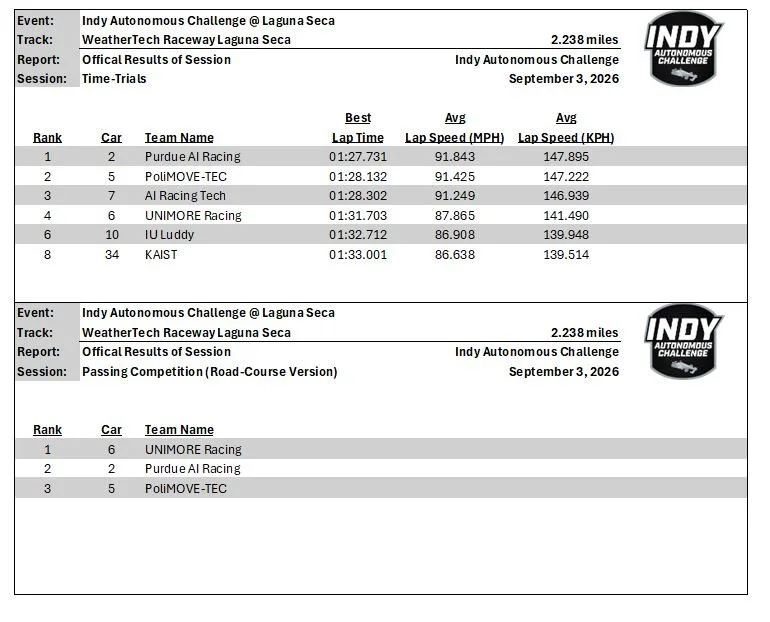
UNIMORE Racing emerged victorious in the Passing Competition, defeating Purdue AI Racing in the final with a bold autonomous overtake into Laguna Seca’s famed Corkscrew, recently renamed the Zanardi Corkscrew in honor of racing legend Alex Zanardi and his iconic 1996 pass at the same corner.
Purdue AI Racing took second place, while PoliMOVE-TEC secured third after successfully overtaking KAIST into the Turn 2 Andretti Hairpin.
“This was a significant step forward for autonomous mobility,” said Paul Mitchell, CEO of Indy Autonomous Challenge and its parent company Aidoptation BV. “Last year, our teams demonstrated how fast an AI driver could navigate Laguna Seca. This year, teams had to engage in wheel-to-wheel racing, pushing the perception and path planning of their AI drivers to the limit. The results were another technological milestone, with 5 high-speed overtakes, no hardware failures on the IAC AV-24 racecars, and no accidents among the AI drivers.”
“Adapting the Passing Competition to a road course required us to rethink how to create a performance differential between the two autonomous racecars,” said Janam Sanghavi, Technical Director of Indy Autonomous Challenge. “Our technical team developed new software modules which allowed Race Control to manage a progressive power differential between the attacking and the defending racecar. IAC Race Control software set different engine maps to the racecars in real time, boosting the attacker's performance advantage by roughly 50-70 horsepower. This demonstrated the ability of high-speed vehicle-to-infrastructure communications to enhance safety and rule following of autonomous vehicles.”
The races were attended by US Assistant Secretary of Transportation for Research and Technology Seval Oz, who served as Grand Marshall for the event. Assistant Secretary Oz spoke to the teams about the national significance of their work and hosted a roundtable with industry, academic, and government leaders, including executives from IAC event sponsor General Motors. The group discussed key capability gaps in autonomous mobility, how university R&D can better align with industry needs, the role of shared test infrastructure, and how high-intensity testbeds such as autonomous racing can help inform future standards, certification, and commercialization.
"This groundbreaking event brought together top-tier university research teams from across the nation and the world to showcase the power and potential of autonomous technology, and we can take those learnings to enhance safety on public roads in the United States," said USDOT Assistant Secretary for Research and Technology Seval Oz.
Four teams qualified for the Passing Competition following a rigorous qualification process that included simulation-based evaluations and successful on-track passing demonstrations during the IAC testing throughout the year. These teams were seeded into a single-elimination bracket.
In the first semifinal, Purdue AI Racing faced KAIST. The two teams finished tied in the match, with Purdue advancing to the final based on the tiebreaker of best lap time during the match. In the second semifinal, both UNIMORE Racing and PoliMOVE-TEC successfully demonstrated passes during Round 1. UNIMORE then completed a second overtake in Round 2 to secure the match and advance to the final. UNIMORE ultimately clinched the championship against Purdue with the decisive pass into the Zanardi Corkscrew. In the third-place match, PoliMOVE-TEC defeated KAIST with a successful overtake into the Turn 2 Andretti Hairpin.
Earlier in the day, six teams competed in the IAC Time Trial. Purdue AI Racing recorded the fastest lap with a time of 1:27.731 and an average speed of 91.843 mph, establishing a new IAC benchmark at WeatherTech Raceway Laguna Seca. PoliMOVE-TEC finished second with a 1:28.132 lap, followed by AI Racing Tech in third with 1:28.302. AI Racing Tech’s performance marked a dramatic progression from 2025, cutting nearly 40 seconds from its Laguna Seca lap time in just one year. The Purdue lap improved on the previous IAC Laguna Seca benchmark of 1:29.792, set during the 2025 competition by PoliMOVE-MSU.
Official results from the IAC Grand Prix of Monterey
About Indy Autonomous Challenge
Indy Autonomous Challenge (IAC) is dedicated to advancing autonomous technologies through high-speed racing. The IAC engineers and constructs the IAC AV-24 racecar and organizes competitions among university-affiliated teams from around the world, challenging them to program AI drivers to pilot fully autonomous racecars. The IAC aims to create a platform for the development and real-world validation of Physical AI systems, driving innovation in the safety and performance of autonomous vehicles.
Founded in 2019, IAC is based in Indianapolis, Indiana, USA. In February 2025, IAC established commercial spin-out company Aidoptation BV, headquartered at DronePort in Sint-Truiden, Belgium. Aidoptation seeks to transition the learnings and technology of IAC’s autonomous racing program to advance safe, secure, sustainable and high-speed autonomous mobility.
Follow IAC on social media for updates and highlights:
LinkedIn: IndyAutonomousChallenge
Instagram: @IndyAChallenge
Facebook: @IndyAChallenge
YouTube: @IndyAutonomousChallenge
About WeatherTech Raceway Laguna Seca
WeatherTech Raceway Laguna Seca is a world-renowned motorsport facility located in Monterey, California, operated and managed by Friends of Laguna Seca, a 501(c)(3) nonprofit. Nestled among scenic hills, it has a rich history of hosting premier racing events, making it a favorite destination for motorsport enthusiasts from around the world. The raceway features challenging turns and elevation changes, including the world-famous Zanardi Corkscrew.
Friends of Laguna Seca is committed to delivering top-tier racing and entertainment experiences year after year.
Contacts
Indy Autonomous Challenge Media Contact: